Mastering Alphabet Color Tracing: A Visual ABC Steps Guide
For anyone involved in early childhood education, from dedicated homeschool parents to classroom teachers and special education professionals, the challenge of teaching letter formation is foundational. We often rely on simple workbooks, but the leap from seeing a letter to correctly forming its strokes can be a significant hurdle for young learners. This is where a thoughtfully designed tool like the Alphabet Color Tracing | ABC Steps Guide transforms the process. It’s not just another printable; it’s a comprehensive visual learning system built on the principle of color-coded, directional guidance. Think of it as a modern, intuitive typeface for the physical act of writing, where every color and dot serves a clear pedagogical purpose.
Anatomy of a Purpose-Built Educational Asset
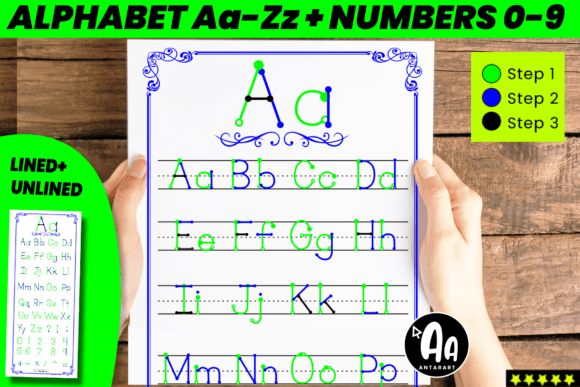
At its core, the A-Z 0-9 Step-By-Step Colored Tracing Guide is a premium font of a different kind—a kinetic one. Its visual character is defined by clarity and structured progression. Each uppercase and lowercase letter, along with numbers 0-9, is deconstructed into individual strokes. These strokes are presented in a specific, intuitive color sequence, often using warm colors for initial strokes and cool colors for subsequent ones, providing immediate visual cues for order. Dots indicate starting points, and directional arrows map the movement, eliminating guesswork. The overall style is clean, uncluttered, and intentionally simple, prioritizing function over decorative flair. Its appeal lies in its ability to make abstract letterforms concrete and manageable, reducing frustration for both the learner and the educator.
This system’s strength is its versatility as a design asset. In a classroom wall decor setting, a large-format print becomes an ever-present reference, reinforcing letter knowledge passively. For homeschooling setups, the included PDF, PNG, and JPG files offer flexibility—print a workbook page for hands-on practice or display it on a tablet for interactive tracing with a stylus. Its application extends into special education, where the consistent color coding and clear spatial cues can be particularly supportive for students who benefit from multi-sensory input and predictable patterns.
Beyond the Worksheet: Practical Applications for Professionals
While the primary audience is educators and parents, the value of such a structured visual guide resonates with a broader creative community. Content creators and bloggers in the parenting and education niches can leverage these resources to create engaging tutorial content, printable freebies for their audience, or visually appealing social media graphics that demonstrate educational techniques. The clean, instructional aesthetic lends itself well to editorial design for parenting magazines or educational blogs.
For marketers and small business owners in the educational product space, understanding the design principles behind tools like the Alphabet Color Tracing Guide is crucial. It informs the creation of packaging design for learning kits, the web design of user-friendly e-commerce sites selling educational materials, and the development of cohesive brand identity that communicates clarity, trust, and effectiveness. A brand that uses such a systematic, child-centered approach in its visuals builds immediate credibility with its adult buyer—the parent or teacher.
Strategic Integration for Maximum Impact
Choosing to integrate a resource like this into your workflow or product offering is a strategic decision. Here’s how to approach it effectively:
- Evaluate Project Fit: Is your goal to teach letter formation, or to use the letterforms as a stylistic element? This guide is a functional tool first. Its strength is in its instructional clarity, not in being a script font or handwritten font for logos. Use it for what it excels at: education and support.
- Consider the Medium: The provided file types (PDF, PNG, JPG) cover most bases. The PDF is ideal for high-quality, scalable printing. PNGs with transparent backgrounds can be layered into digital designs for worksheets or presentations. JPGs are perfect for quick digital display. For digital learning, ensure the on-screen version has sufficient contrast and size for young eyes.
- Mind the Pairings: If you’re designing a full educational worksheet or poster, the tracing charts pair best with simple, highly legible sans serif fonts for instructions and labels. Avoid competing with the visual complexity of the tracing guides. A clean modern typography approach for accompanying text ensures the color-coded strokes remain the focal point.
- Leverage for Engagement: The color-coding isn’t just for guidance; it’s a built-in engagement tool. In a classroom, you can turn it into a game: "Can you trace the red part first?" This transforms rote practice into an interactive activity, boosting audience engagement and making learning sticky.
In essence, the Alphabet Color Tracing | ABC Steps Guide is more than a printable chart. It’s a carefully crafted design asset that applies core principles of visual hierarchy and user-centered design to a fundamental educational challenge. Its value lies in its ability to bring consistency, reduce cognitive load, and build confidence—one color-coded stroke at a time. For professionals in education and creative fields, it represents a practical, effective solution grounded in the real-world needs of early learners.